

Bulk carriers, container ships, tankers each contribute $1 billion as the cargo shipping market expands by $3.6 billion
Cargo shipping market
Cargo shipping market

Cargo shipping market
The Business Research Company’s cargo shipping Global Market Report 2026 – Market Size, Trends, And Forecast 2026-2035
LONDON, GREATER LONDON, UNITED KINGDOM, October 16, 2026 /EINPresswire.com/ -- The cargo shipping industry is experiencing significant advancements as it prepares for substantial growth over the next several years. Driven by innovations, evolving trade patterns, and regulatory changes, this sector is adapting to meet the demands of global commerce more efficiently and sustainably. The following overview explores the market’s size, key drivers, competitive landscape, and emerging trends shaping its future.
Cargo Shipping Market Size and Projected Growth
Between 2025 and 2030, the cargo shipping market is expected to increase in value by more than $3.6 billion. Bulk carriers, container ships, and tankers will each contribute roughly $1 billion to this expansion. By 2030, the total market size is projected to surpass $16 billion, growing at a compound annual growth rate of 5%. This growth represents about 1% of the larger Couriers And Messengers market, which is anticipated to reach approximately $1,662 billion by 2030. Within the even broader Transport Services industry, valued at around $12,477 billion by 2030, cargo shipping will account for close to 0.1% of overall market value.
Request A Free Sample Of The Cargo Shipping Market Report
https://thebusinessresearchcompany.com/sample_request?id=16645&type=smp&name=Cargo%20Shipping%20Market%20Report%202026&utm_source=EINPresswire&utm_medium=Paid&utm_campaign=Oct_PR
Innovations Led by Electric Container Ships in Cargo Shipping
A major technological breakthrough in the cargo shipping sector is the introduction of electric container ships, which are significantly reducing maritime emissions and improving energy efficiency. These vessels support the transition to greener freight transport along key global routes. For example, in May 2024, China Ocean Shipping Company Limited launched the world’s first 10,000-DWT pure electric container ships, Green Water 01 and Green Water 02. Designed for the Yangtze River and coastal services, these ships feature high-capacity battery systems, zero direct emissions, and scalable energy storage solutions that enhance environmental performance and reduce fuel reliance.
Main Drivers Fueling Cargo Shipping Market Expansion
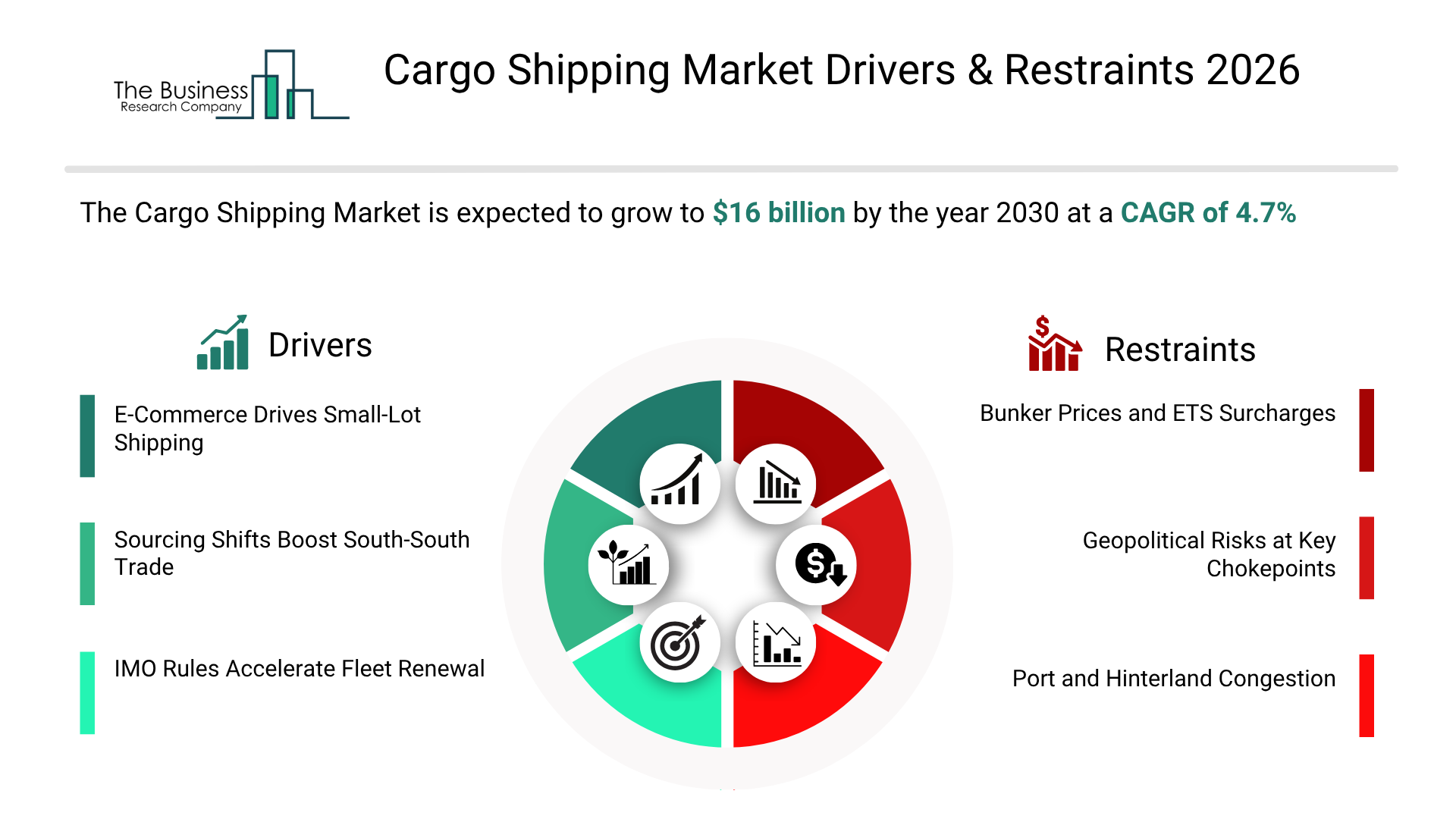
The cargo shipping market is propelled by several key trends that will accelerate its growth through 2030. One significant factor is the rise of e-commerce, which has dramatically increased the frequency and volume of small-lot international shipments. This shift demands faster replenishment cycles, more flexible cargo routes, and reliable shipping options. Sea transport has become essential for meeting consumer demand for imported goods, especially in regional and global distribution networks. This trend is expected to contribute roughly 2.0% to annual market growth.
Access The Detailed Cargo Shipping Market Report Here
https://thebusinessresearchcompany.com/report/cargo-shipping-global-market-report?utm_source=EINPresswire&utm_medium=Paid&utm_campaign=Oct_PR
Another important influence is the change in global sourcing patterns, which has bolstered South-South trade. Emerging economies across Asia, Latin America, the Middle East, and Africa are establishing new shipping corridors and strengthening trade relationships. Increased industrial production and export capabilities in these regions are driving a rise in cargo volumes. This dynamic is also estimated to support a 2.0% yearly growth in the market.
Regulatory Shifts Encouraging Fleet Modernization
International Maritime Organization (IMO) regulations are playing a crucial role in accelerating fleet renewal across the cargo shipping industry. Stricter rules on emissions and fuel efficiency motivate operators to invest in newer vessels equipped with advanced propulsion systems and environmentally friendly technologies. This push toward modernization not only enhances operational performance but also encourages innovation in ship design. The impact of IMO regulations is predicted to add about 1.9% annual growth to the market.
Regional Market Outlook with Asia Pacific Leading
Asia Pacific is set to remain the largest market for cargo shipping by 2030, growing from $5 billion in 2025 to $6 billion. This expansion is fueled by increasing intra-Asia trade routes, rising exports from manufacturing hubs in China, India, Vietnam, and Southeast Asia, and ongoing investments in port upgrades and maritime infrastructure. The region’s strategic position as a major global trade and transshipment hub also supports this growth trajectory, along with the rising volume of containerized cargo linked to e-commerce and industrial activity.
The United States is forecast to be the single largest country market in cargo shipping by 2030, with a value of $4 billion, up from $3 billion in 2025, growing at a 4% CAGR. This steady increase reflects higher seaborne imports and exports, enhanced logistics and supply chain networks, expanding trade in energy and industrial goods, investments in smart port technology, and the presence of leading shipping companies servicing both domestic and international maritime commerce.
Market Segments and Bulk Carriers’ Dominance
Within the cargo shipping market, bulk carriers, general cargo ships, container ships, tankers, reefer ships, and other vessel types represent distinct segments. Bulk carriers are projected to maintain the largest share by 2030, accounting for 37% of the market or approximately $6 billion. Their growth is driven by increasing shipments of dry bulk commodities such as coal, iron ore, grains, and bauxite. Demand from industries like steel manufacturing and power generation, along with cost-effective large-volume transport and fleet expansion, supports this dominance.
Additional market breakdowns include segmentation by cargo type—liquid cargo, dry cargo, and general cargo—as well as by industry sectors such as food and beverages, manufacturing, retail, oil and gas, automotive, pharmaceutical, electrical and electronics, among others.
Leading Companies and Competitive Market Landscape
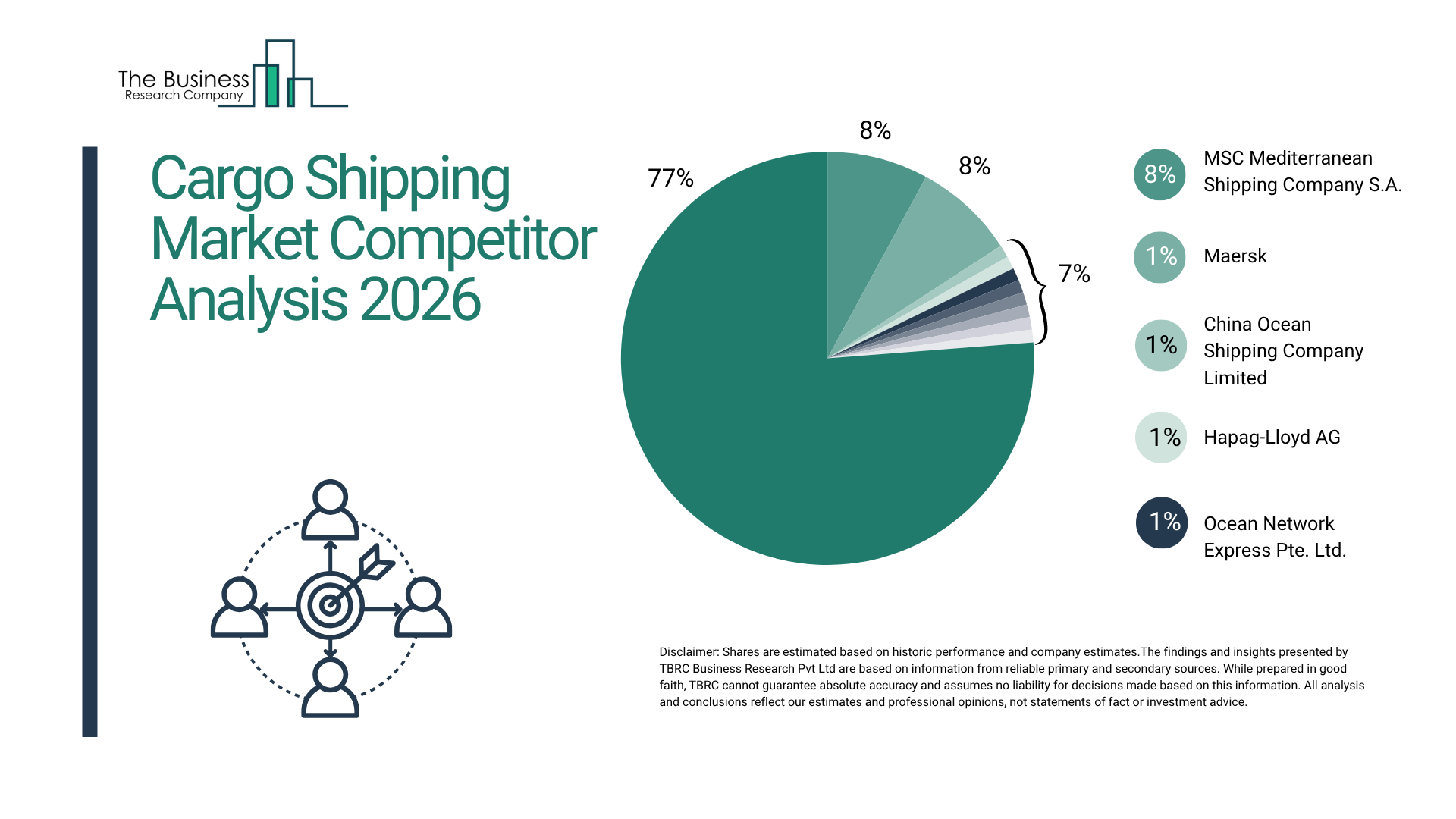
MSC Mediterranean Shipping Company S.A. held the largest global market share in 2024, capturing 8%. This company’s comprehensive shipping and logistics services, including container transport, intermodal logistics, terminal management, and maritime freight, play a vital role in supporting international trade and supply chain resilience. Other key market players include Maersk, China Ocean Shipping Company Limited, Hapag-Lloyd AG, Ocean Network Express Pte. Ltd., Evergreen Marine Corp. Ltd., Mitsui O.S.K. Lines Ltd., Hyundai Merchant Marine Co. Ltd., Yang Ming Marine Transport Corporation, and several others.
Market Fragmentation and Industry Barriers
The cargo shipping industry is moderately fragmented, with the top 10 players accounting for 23% of total revenue in 2024. Significant capital investment requirements, complex regulatory frameworks, extensive port connectivity demands, and the need for global logistics expertise create substantial barriers to entry. Leading companies compete by maintaining large and diverse fleets, offering broad geographic coverage, and investing in digital logistics platforms and fleet modernization. Increasing demand for efficient freight transport, supply chain resilience, sustainable shipping, and improved cargo visibility are expected to promote innovation, strategic alliances, and network expansion among market leaders.
Strategies Companies Are Using to Stay Competitive
To maintain and strengthen their market positions, cargo shipping companies are focusing on several strategic approaches. Digital transformation through smart shipping platforms is enhancing operational efficiency. Autonomous navigation technologies are being adopted to improve maritime safety and productivity. Additionally, green fuels and low-emission technologies are becoming central to sustainable shipping efforts. Companies are also forming strategic partnerships to boost global trade route connectivity and investing in fleet modernization to improve cargo capacity and overall vessel performance.
The Complete Cargo Shipping Market Value Chain
The cargo shipping market’s value chain involves numerous key suppliers, distributors, and end users. Major raw material providers include Nippon Steel Corporation, POSCO Holdings Inc., ArcelorMittal S.A., JFE Steel Corporation, HBIS Group Co. Ltd., China Baowu Steel Group Corporation Limited, Nucor Corporation, SSAB AB, Hyundai Steel Company, Voestalpine AG, Mitsubishi Heavy Industries Marine Machinery & Equipment Co. Ltd., Wärtsilä Corporation, MAN Energy Solutions SE, SKF AB, and leading marine fuel suppliers such as Shell Marine Products, Chevron Marine Lubricants, ExxonMobil Marine Fuels, TotalEnergies Marine Fuels, along with coating companies like Akzo Nobel N.V. and Hempel A/S.
Among prominent wholesalers and distributors are DHL Global Forwarding, Kuehne + Nagel International AG, Expeditors International of Washington Inc., C.H. Robinson Worldwide Inc., GEODIS SA, Sinotrans Limited, Yusen Logistics Co. Ltd., Hellmann Worldwide Logistics SE & Co. KG, Kerry Logistics Network Limited, Nippon Express Holdings Inc., Blue Water Shipping A/S, BDP International Inc., Scan Global Logistics A/S, Savino Del Bene S.p.A., Rhenus Logistics SE & Co. KG, Nippon Yusen Kaisha, and Mitsui O.S.K. Lines.
Leading end users span a wide range of industries and include Walmart Inc., Amazon.com Inc., Toyota Motor Corporation, Samsung Electronics Co. Ltd., Apple Inc., Volkswagen AG, Exxon Mobil Corporation, Saudi Arabian Oil Company (Saudi Aramco), BASF SE, Nestlé S.A., Unilever PLC, Procter & Gamble Company, The Coca-Cola Company, Pfizer Inc., Intel Corporation, LG Electronics Inc., Reliance Industries Limited, BHP Group Limited, Cargill Incorporated, and IKEA Supply AG.
Where the Cargo Shipping Market Will Add Value by 2030
The primary growth opportunities within the cargo shipping market are expected across bulk carriers, general cargo ships, container ships, tankers, reefer ships, and other vessel types. Together, these segments are forecast to contribute over $3.6 billion in added value by 2030. Between 2025 and 2030, bulk carriers, container ships, and tankers will each see growth of around $1 billion. General cargo ships are projected to add $0.3 billion, reefer ships $0.2 billion, and other types $0.1 billion. This expansion will be driven by the increasing seaborne transport of industrial commodities, containerized goods within global supply chains, growing energy and liquid cargo trade, temperature-controlled shipping of food and pharmaceuticals, and ongoing investment in fleet optimization and cargo handling efficiency. These trends reflect the broader focus on enhancing trade connectivity, productivity, and adapting to changes in global commerce.
Our latest 2026 market reports provide expanded strategic and visual intelligence with market attractiveness scoring and analysis, total addressable market (TAM) analysis, company scoring matrix graphics and tables, Excel-based forecasting dashboards, market hotspots infographics, key technologies and future trend analysis, together with updated graphics and tables.
Learn More About The Business Research Company
The Business Research Company (www.thebusinessresearchcompany.com) is a leading market intelligence firm renowned for its expertise in company, market, and consumer research. We have published over 30,000+ reports across 27 industries and 60+ geographies. Our research is powered by 1,500,000 datasets, extensive secondary research, and exclusive insights from interviews with industry leaders.
We provide continuous and custom research services, offering a range of specialized packages tailored to your needs, including Market Entry Research Package, Competitor Tracking Package, Supplier & Distributor Package and much more.
Disclaimer: Please note that the findings, conclusions and recommendations that TBRC Business Research Pvt Ltd delivers are based on information gathered in good faith from both primary and secondary sources, whose accuracy we are not always in a position to guarantee. As such TBRC Business Research Pvt Ltd can accept no liability whatever for actions taken based on any information that may subsequently prove to be incorrect. Analysis and findings included in TBRC reports and presentations are our estimates, opinions and are not intended as statements of fact or investment guidance.
Contact Us:
The Business Research Company
Americas +1 310-496-7795
Europe +44 7882 955267
Asia & Others +44 7882 955267 & +91 8897263534
Email: marketing@tbrc.info
Follow Us On:
LinkedIn: https://in.linkedin.com/company/the-business-research-company
Oliver Guirdham
The Business Research Company
+44 7882 955267
Visit us on social media:
LinkedIn
Facebook
X
Legal Disclaimer:
EIN Presswire provides this news content "as is" without warranty of any kind. We do not accept any responsibility or liability for the accuracy, content, images, videos, licenses, completeness, legality, or reliability of the information contained in this article. If you have any complaints or copyright issues related to this article, kindly contact the author above.
